The Eight Squadrons of Death
Dario Argento's supernatural thriller draws on a fascinating chapter in forensic history, where the changing chemistry of a corpse attracts successive waves of insects—and where death leaves behind a biological timeline.
"Cadaver-eating insects are divided into eight groups. These eight groups of insects come to the corpse one after the other. And this, only in certain moments and at a precise time. Never sooner and never later. We call them the eight squadrons of death. First, the common fly comes to the rotting corpse and lays its eggs. This is the beginnig of the cycle. Each group of insects stays for exactly fifteen days.”
— Professor McGregor, Phenomena (1985)
There is something particularly fascinating about the way Phenomena approaches death. Beneath its supernatural premise, Dario Argento's film introduces a veritable scientific concept. Professor John McGregor, the film's forensic entomologist, introduces investigators to what he calls the eight squadrons of death—a fictional title for the process of insect succession. As a corpse decomposes, different groups of insects arrive in response to its changing conditions. By identifying the insects present and examining their development, investigators can work backward toward an estimate of when death occurred.
When I first encountered this concept in the film, what particularly caught my attention was its numerical structure. The phrase ‘eight squadrons of death’ initially brought to mind the ‘seven deadly sins’, but with a number carrying a different symbolism. In astrology, the number eight is associated with Uranus, the planet of liberation, transcendence, and breaking free from the boundaries of the material world. The number itself, turned on its side, becomes the symbol for infinity. There was something particularly fitting about finding this symbolism in the process that turns death into the continuation of life.
That association was part of what prompted me to look beyond the film's dialogue and investigate how much of its morbid science was actually grounded in forensic research.
As it turns out, the history behind the scene is nearly as fascinating as the fiction.
the origins of forensic entomology
The pioneering figure behind forensic entomology was French entomologist Jean Pierre Mégnin.
By studying the insects that colonize decomposing bodies, Mégnin demonstrated that their successive arrival could provide valuable clues about the time elapsed since death. His work established the basis for estimating the postmortem interval (PMI), a method that would become an important tool in modern forensic investigations.
His research developed over several publications. An earlier work, Faune des tombeaux (Fauna of the Tombs), published in 1888, explored the fauna associated with graves. This was followed by his landmark publication, La Faune des Cadavres (The Fauna of Corpses), published in Paris 1894 and considered the birth of forensic entomology.
The 214-page illustrated volume brought together years of observations concerning the successive colonization of corpses by insects and mites. It also included nineteen forensic case reports, demonstrating how these observations could be applied to actual investigations.
Mégnin's research distinguished between bodies exposed to the open air and those that had been buried. His eight successive insect waves concerned corpses exposed to the elements. For buried remains, he described a different, much more limited succession involving two waves.
The underlying principle of his research shows that decomposition changes the chemical and biological environment of a corpse. As tissues break down, the body becomes attractive to different organisms at different points in the process. Some arrive to feed or reproduce; others arrive to feed on the insects already inhabiting the remains.
The changing composition of the corpse therefore creates a succession of insect populations. Mégnin recognized that these populations could provide valuable information about the history of a body, effectively turning its insect inhabitants into evidence of the passage of time.
the phenomenon of faunal succession
The science behind the phenomenon is known as faunal succession. Following death, the body's internal environment begins to change. Cellular breakdown, bacterial activity, and the chemical processes of putrefaction produce new and volatile organic compounds (VOCs), some of which can be detected by insects.
These changing chemical signals, along with the availability of different food sources, help determine which organisms are attracted to the remains.
The earliest visitors are commonly flies, particularly blowflies and flesh flies. Their ability to locate suitable material for reproduction makes them especially important in forensic investigations. Depending on the species, females deposit eggs or larvae on accessible tissues, and the developing larvae subsequently feed on the remains.
As decomposition progresses, the environment changes again. Other flies, beetles, mites, and additional arthropods become more prominent. Some feed directly on decomposing tissue, while predatory species feed on the larvae and other organisms already present.
Eventually, as the remains dry and the availability of moist tissue diminishes, the community changes once more. Insects adapted to consuming dried animal material appear, including moth larvae and certain dermestid beetles.
This is the biological succession that makes forensic entomology possible.
Investigators identify the species, examine the developmental stage of the insects, consider their life cycles, and interpret the findings alongside other environmental and crime-scene evidence.
The oldest insect specimens are usually the most useful. Their developmental age can help establish a minimum postmortem interval, although the actual time since death may be longer than the period of insect activity.
Temperature is especially important because it affects insect development. Season, humidity, geographic location, sunlight, access to the body, and whether the remains were buried or submerged can all influence the process.
In other words, the body is a biological clock, but it is not a clock that runs at precisely the same speed in every environment.
The Science Behind the Supernatural
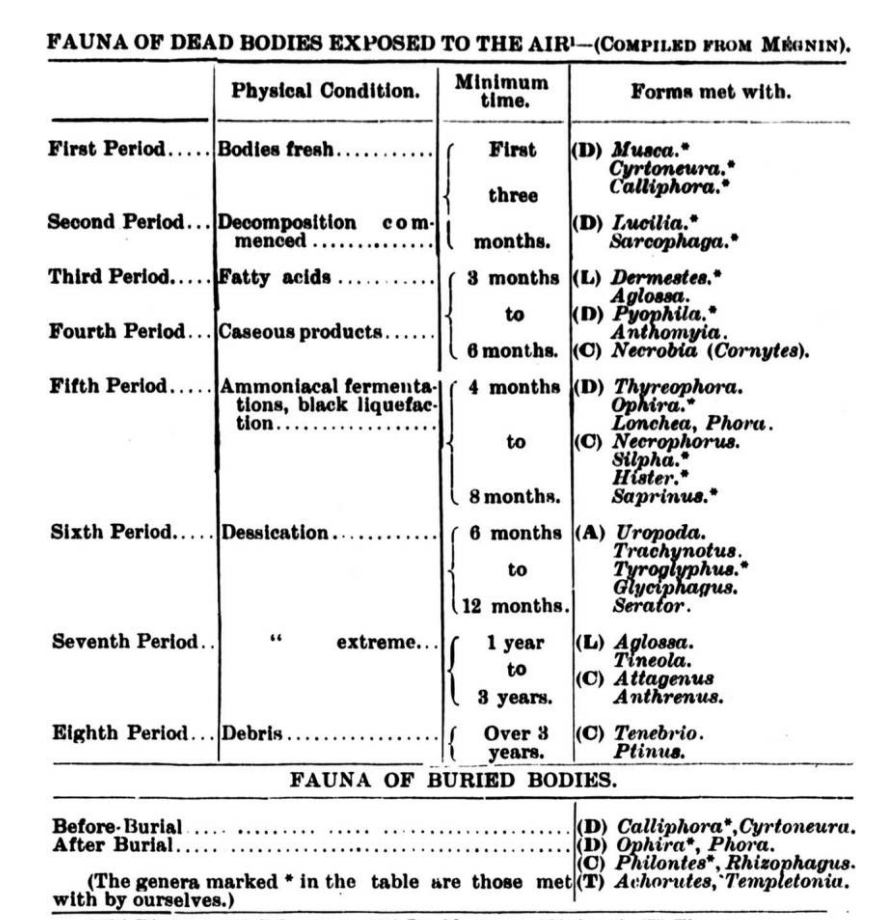
Mégnin's theory of successive insect colonization divided the decomposition of an exposed corpse into eight distinct periods, which Phenomena (1985) called squadrons. Each squadron represented a different assemblage of insects attracted to the changing chemical conditions of the body. As one phase gave way to another, the substances released by the corpse changed, creating an environment more suitable to different organisms.
The First Squadron — Fresh Bodies
The first arrivals were flies, particularly members of the Musca, Cyrtoneura, and Calliphora genera. These insects were attracted to the body shortly after death, when its tissues were still relatively fresh. This initial colonization marked the beginning of the succession.
The Second Squadron — Dawn of Decomposition
As decomposition advanced, a new group of flies appeared, including Lucilia and Sarcophaga. Their arrival corresponded with the body's developing putrefaction and the chemical changes accompanying it.
The Third Squadron — Fatty Acids
As the breakdown of fats produced fatty acids, the body attracted a different assemblage of organisms. This period was characterized by dermestid beetles, particularly the Dermestes genus, alongside the moth Aglossa.
The Fourth Squadron — Caseous Products
As decomposition progressed and protein-rich tissues began breaking down into caseous, or cheese-like, substances, another group arrived. This squadron included cheese flies of the Piophila genus, along with Anthomyia flies and Necrobia beetles.
The Fifth Squadron — Fermentations
The next period was characterized by ammoniacal fermentation and the liquefaction of remaining tissues. Its associated fauna included several types of flies, such as Thyreophora, Ophyra, Lonchaea, and Phora, as well as carrion and predatory beetles, including Necrophorus, Silpha, Hister, and Saprinus.
The Sixth Squadron — Desiccations
As the remains began to dry, mites became the dominant group. Mégnin recorded several genera, including Uropoda, Trachynotus, Tyroglyphus, Glyciphagus, and Serator. Unlike the preceding squadrons, this period was composed entirely of mites.
The Seventh Squadron — Extreme Desiccations
With the body reduced to increasingly dry remains, another assemblage appeared. This group included moths such as Aglossa and Tineola, alongside dermestid beetles such as Attagenus and Anthrenus, which feed on the remaining dry organic material.
The Eighth Squadron — Debris
The final squadron was associated with the residual debris left behind by the preceding waves. It included beetles of the Tenebrio and Ptinus genera, marking the last period in Mégnin's succession.
Mégnin's eight periods were an early attempt to organize the relationship between insect succession and the changing condition of a corpse. Later forensic research brought this progression into a broader classification of five recognizable postmortem stages: fresh, bloated, active decay, post-decay, and skeletonization. Rather than distinguishing the successive chemical changes that attract different organisms, this modern framework groups decomposition according to the physical condition of the remains. In doing so, several of Mégnin's original periods were consolidated; notably, his first two were later treated as a single wave of insect activity.
Following the Great Sarcophagus
One of the most memorable aspects of Phenomena is Jennifer Corvino's relationship with insects. Her ability to communicate with them and influence their behavior creates the supernatural horror. In the film, Jennifer uses an insect's natural attraction to biological material to help locate evidence connected to the string of murders.
Although her connection with insects and their courtship rituals is fictional, the principle that insects can locate concealed remains through chemical cues is consistent with the foundations of forensic entomology.
Insects are not merely incidental visitors to a crime scene. Their presence, absence, developmental stages, and species composition can all provide valuable investigative evidence.
This is what makes the film's premise so compelling. Argento takes an actual scientific discipline and turns the natural behavior of insects into a form of communication between the living and the dead.
A corpse becomes an ecosystem. Its changing chemistry summons successive inhabitants. And those inhabitants, in turn, preserve clues about the time and circumstances of its death and decomposition.
There is something undeniably poetic about the idea that even after death, the physical body continues to communicate with the world around it.
In Phenomena, that communication becomes a mystery waiting to be deciphered.